

This article originally appeared on Weijin Research on Huxiu on September 20, 2026. Original Chinese title: 「AI做多印度,做空印度软件外包」. It has been translated and adapted for an English-speaking audience.

Search for the industry most easily destroyed by AI, and Indian software outsourcing almost always ranks first on the media's list.
The reason is very simple. The business model of India's IT services industry over the past 30 years has been to organize millions of well-educated, English-speaking engineers whose cost is significantly lower than in Europe and the United States, and to move the software development, testing, maintenance and back-office processes of American and European enterprises to Bangalore, Hyderabad and Pune. TCS, Infosys and Wipro built enormous human pyramids: a handful of architects and project managers at the top, an immense number of young programmers below, and then billing clients according to how many engineers are deployed and how many hours they work.
But Claude Code, Codex and increasingly powerful coding agents replace precisely the core factor of production in this model: the time of junior programmers.
If one engineer with a few agents can do the work that used to take five people, why should a client still pay for five people? If AI can write code, generate tests, find bugs and migrate legacy systems on its own, what meaning is left in the unlimited supply of cheap programmers on which India relied for decades of success?
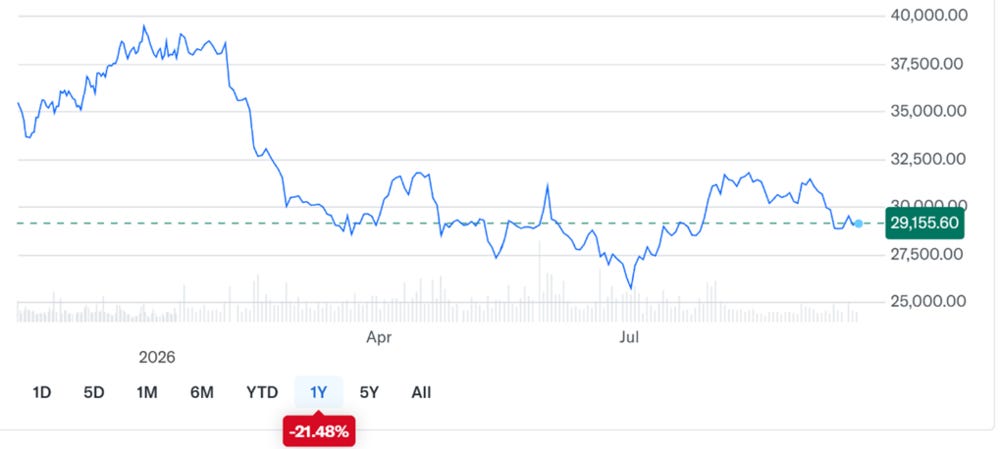
The market has given a rather pessimistic answer. As of mid-September this year, India's Nifty IT index had fallen about 21% year to date, more than double the decline of the broader market. TCS, Infosys, Wipro and HCLTech are all under pressure from clients pushing down prices and shortening contracts, and AI has also brought some work back inside client organizations.
Line chart of a market index over roughly one year ending 2026, with a volume subplot and a highlighted 1-year return of -21.48%.
But a set of data released by the Reserve Bank of India (RBI) on September 18 gave this market story a contrarian side.
In fiscal year 2025/26, India's software services exports did not shrink at all; they grew 8.2% year on year to $221.4 billion. If the local business of Indian companies' overseas subsidiaries is included, the total reached $239.3 billion, up 9.5% year on year. Of that total, exports to the United States reached $119.7 billion, growing about 11%, and the United States' share of India's software exports actually rose from 52.9% to 54.1%. 91.7% of services were already delivered offshore.
Line chart of India's software services and business services exports as a share of total service exports, June 2018 to June 2026.
(Source: ING Think)
Even more noteworthy is the internal structure. IT services grew from $131.3 billion to $147 billion, an increase of 12%; engineering services rose from $10.8 billion to $12 billion; but BPO (business process outsourcing), the segment closest to the traditional labor-intensive model, barely grew, going from $55.8 billion to $56 billion. Software product exports even fell from $6.8 billion to $6.4 billion.
Coding agents are clearly eliminating human hours of code work, yet India's software and digital services exports continue to grow. AI must be shorting one old business model within India's software industry and going long a new kind of value.
Why India was able to become the world's back office
The rise of India's software industry was itself a historical "accident" produced jointly by a technological change, globalization and comparative advantage in labor.
In 1988, India's software exports were still less than $200 million. A decade later, in 1998, they had reached $3.6 billion. Y2K was a key turning point: a large number of Western enterprises had to modify the year representations in old code, work that was tedious and labor-intensive yet impossible not to do. World Bank research estimates that from 1996 to 1999, Y2K alone brought Indian software companies about $2.5 billion in revenue. Europe's adoption of the euro subsequently created another round of similar software migration demand.
India happened to possess a set of factors of production rare in the world: a large number of science and engineering graduates, English ability, wages far below those in Europe and the United States, a vast overseas Indian network, and long-established relationships of trust with American enterprises. Economic liberalization after 1991, software parks, international communications lines and internet infrastructure then gradually turned "body shopping," in which programmers had to be dispatched to American clients' offices, into genuine offshore development.
Indian companies thus completed their first upgrade: from exporting programmers to exporting software projects.
And scale itself formed a new moat. When a bank's core system has a problem, what the client needs is not just a few smart programmers, but an organization that can mobilize 5,000 people, cover dozens of countries, understand financial regulation, SAP, Oracle, mainframe systems and the client's twenty years of legacy code. What TCS and Infosys built was in fact a capacity for industrial-scale software production. This density of tens of thousands of coders is somewhat similar to the contract factories of Chinese manufacturing.
But this success also planted the seeds of today's problems. Revenue was long highly correlated with headcount and hours. The larger a contract, the more people it needed; a company with 600,000 engineers was itself a competitive advantage in the past. So companies formed enormous "pyramids": hiring large numbers of university graduates every year, having them start with testing, maintenance and basic coding, and then moving up level by level. Coding agents suddenly cut away the base of this pyramid.
What AI is really destroying is selling software by the head
The basic formula of software outsourcing in the past was: more projects × more engineers × more billable hours = more revenue. AI has rewritten this formula.
TCS announced last year that it would cut about 12,200 people; this year hiring at several of India's largest IT companies has almost stalled. Data cited by ING says that in the first nine months of fiscal year 2026, the total net headcount increase of India's leading IT companies was only 17 people. At the same time, Wipro disclosed in September this year that the productivity gains from AI applications internally were equivalent to freeing up the capacity of 20,000 employees. These people were not all laid off; they were retrained and redeployed. The same revenue no longer requires the same number of heads.
Clients, of course, have seen this too. They now demand higher productivity and lower quotes from Indian service providers, and are increasingly unwilling to pay for headcount. At TCS, in business services such as finance and human resources, about 80% of contracts are now tied to outcomes, double the proportion before generative AI rose on a large scale. Some clients simply use AI to bring work that was once outsourced back in house. Contract durations are also shortening.
The real impact of AI on Indian IT service providers is not that software no longer needs people to make it, but that work hours are losing their meaning as the unit of measurement for the value of software.
If in the past a client bought 100 Indian engineers for a year, what it really wants to buy now is to cut the cost of a bank's back office by 20%, migrate a legacy system to the cloud, compress software release time from six months to six weeks, or have 80% of customer service processes handled by agents. In other words, I no longer want you to count how many heads and how many hours were used; rather, you create results for me.
The Indian government's own judgment is even more direct than that of many companies. India's national think tank NITI Aayog published a report this year, "Technology Services – Reimagination Ahead," proposing that India must move from being the world's "back office" to being the world's "AI-native Architect"; from effort-based billing to result-driven engagements, from one-off custom coding to IP and platforms, and from back-office IT support into core enterprise business transformation. This is in effect a death notice for the old Indian model.
India did not preserve its old industry, but is switching to a new one
Why are software exports still growing? ING's research published on September 16 grasped the most important change.
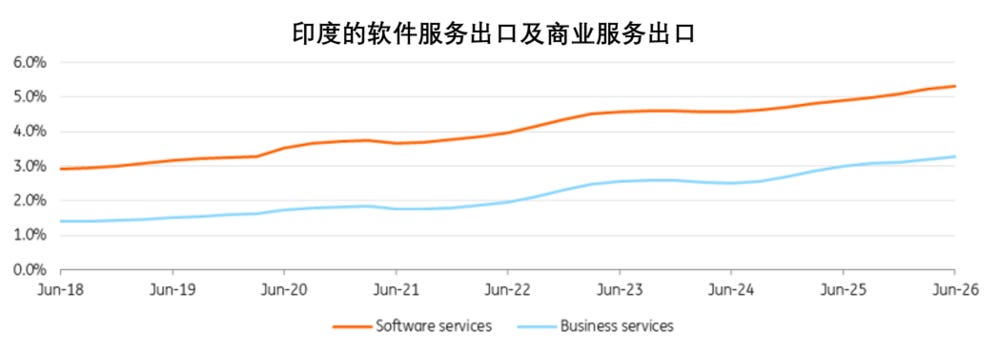
India's software services currently amount to about 5.2% of GDP, versus only 3.3% before the pandemic; particularly noteworthy is that since ChatGPT appeared in 2022, this proportion has increased by another roughly 1 percentage point. At the same time, business services including finance, law, consulting, risk management, R&D, engineering design and data analysis have risen from the equivalent of 1.6% of GDP before the pandemic to 3.3%. In other words, value is moving upward.
The work most easily replaced by AI is data entry, junior customer service, standard testing, simple coding and rule-based back-office processing; the faster-growing areas are engineering, product design, data, cybersecurity, financial analysis, compliance, R&D and the deployment of AI systems themselves.
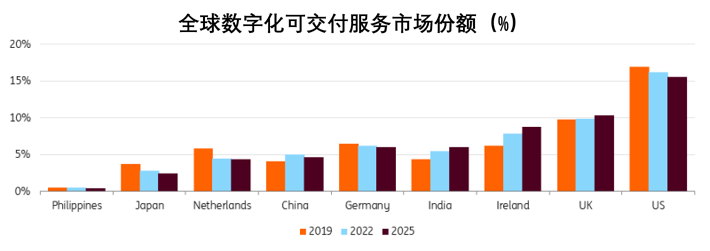
This also explains an apparent statistical problem. To observe this change, ING used a broader measure of digitally delivered services (DDS) than traditional software outsourcing. This indicator includes not only computer services but also professional consulting, financial services, management, R&D and other knowledge services that can be delivered across borders via the internet.
Bar chart of global digitally deliverable services market share by country for 2019, 2022, and 2025.
(Source: ING Think)
Since 2022, India's DDS exports have grown 45%, while globally they grew only 32% over the same period; of which, other business services grew at an average annual rate of about 15%, clearly above the global growth rate of 9.3%. So there is indeed an issue of a broader statistical measure, but it cannot be said on that basis that India's growth is merely a statistical illusion.
The RBI did not change to a DDS measure. By the relatively stable software services statistics, exports still grew 8.2% in fiscal year 2025/26, and IT services and engineering services grew markedly. ING used DDS in order to see the other part of India's digital economy that is expanding rapidly beyond the RBI's software statistics.
What has really changed is the boundary of "Indian outsourcing." In the past, an American bank handed a project to Infosys; that was outsourcing. Now, an American bank directly establishes its own Global Capability Center (GCC) in Bangalore, hiring Indian engineers, data scientists, quantitative analysts and AI researchers who directly participate in global product R&D. This is no longer outsourcing in the traditional sense, but for India it is still knowledge work, services exports and high-paying employment.
As of fiscal year 2026, India is expected to have about 2,117 GCCs, 2.36 million employees and about $100 billion in revenue. More importantly, companies are establishing GCCs less and less for cheap back-office work, and more and more for AI, cybersecurity, product development, automotive software and even drug discovery. India's traditional outsourcing companies are losing business, but India is simultaneously gaining more global technology work.
This time, what India got right and what it got wrong
The first thing India got right was not trying to protect the original employment model. This is true from the government to the companies.
Although the large companies have moved at different speeds, the direction is already clear. TCS proposed becoming a "full-stack AI service provider," from AI data centers all the way to agentic AI applications; Infosys turned Topaz into an AI-first services and agent platform and partnered with OpenAI to use Codex for software engineering and legacy system modernization; Wipro this year specifically established an AI-native business and platform unit and explicitly set out toward "services as software."
Another important change is the reappearance of the forward-deployed engineer (FDE). TCS plans to build an FDE team of up to about 8,900 people, and Infosys about 6,000. Engineers no longer hide in Indian delivery centers taking requirements and writing code; instead they enter client sites, understand workflows, data, organizations and business objectives, and then decide what AI should replace and what it should restructure. This in fact pushes Indian companies one step toward a Palantir-style service model.
The second thing done right was allowing GCCs to expand rather than viewing them as a threat to domestic outsourcing companies. Multinational companies building technology centers directly in India will take away Infosys' talent and orders, but they simultaneously raise the capability of the entire Indian technology ecosystem. After a person works for a few years at the India R&D center of JPMorgan, Microsoft, BMW or AstraZeneca, what they take away is vertical domain knowledge in industries such as finance, automotive and pharmaceuticals, and this is precisely a capability more precious than writing code in the agent era.
The third thing was that the government began to fill in the public infrastructure missing in the AI era. The IndiaAI program has expanded shared computing capacity to more than 45,000 GPUs, while also building the AIKosh data platform, FutureSkills, domestic foundation models, AI startup financing and safe and trustworthy AI frameworks.
But the places where India "got it wrong" are equally obvious. The biggest problem is that it has been too successful at services while for a long time not successful enough at products.
NITI Aayog itself admits that India already accounts for about 20% of the global technology services market, but only 1% to 3% of the global SaaS market. India has about 3,500 SaaS companies, yet has not formed software IP and platform value commensurate with the scale of its services industry. Talent cultivation remains highly services-oriented; AI-ready computing power is insufficient; there is a shortage of high-end general AI research, large language model operations and product manager talent; and R&D investment is also insufficient. NITI even explicitly recommends that large services companies raise R&D investment to 1% to 2% of revenue.
This contrast is very sharp: India is good at helping American enterprises do software well, but not good enough at creating global software of its own. After the emergence of coding agents, this shortcoming has become even more dangerous. Because AI first compresses the price of coders' work, while those who own models, platforms, data and IP may instead earn higher profits.
A new generation of Indian companies no longer looks like traditional outsourcing firms
Therefore what is truly worth observing may not only be how TCS and Infosys save themselves, but who will become the next generation of Indian enterprise services companies. Persistent and Coforge have already shown some signs. From April to June this year, when TCS, Infosys, Wipro and HCLTech grew only about 1% to 3%, Persistent's revenue grew 16% and Coforge's grew by about one third. They are smaller, with no hundreds of thousands of employees to protect, so they find it easier to accept AI eating up old revenue and then use AI to compete for new revenue.
Persistent has built platforms such as SASVA and GenAI Hub; Coforge launched the Nuuron AI Operating System and the AI Launchpad. What they want to do is no longer simply deliver projects, but package work that used to be redone from scratch for each client into software and agents that can be sold repeatedly.
Even more typical is Fractal. From the start it was a data, analytics and AI company, rather than one transformed from traditional IT outsourcing. Its revenue in fiscal year 2026 grew 19% year on year; it has more than 5,800 employees, serves more than 100 large enterprises, and is turning an agent platform such as Cogentiq into a product.
Similar ones include AI data/native service providers such as Quantiphi, Tredence and Tiger Analytics. One layer further down, model companies such as Sarvam have appeared. This year Sarvam raised $234 million at a valuation of $1.5 billion, with HCLTech alone planning to invest $150 million, symbolizing that the old outsourcing giants are actively buying new AI-native capabilities rather than waiting for those capabilities to destroy them.
Will the Indian IT company of the future be consulting, outsourcing, software or an AI company? It may be all four.
The largest overseas market for OpenAI and Anthropic
India is not only the world's largest base for IT services, but is also becoming the largest overseas user base for American AI models.
OpenAI has publicly stated that India already has more than 100 million weekly active ChatGPT users, making it ChatGPT's second-largest market globally, after the United States.
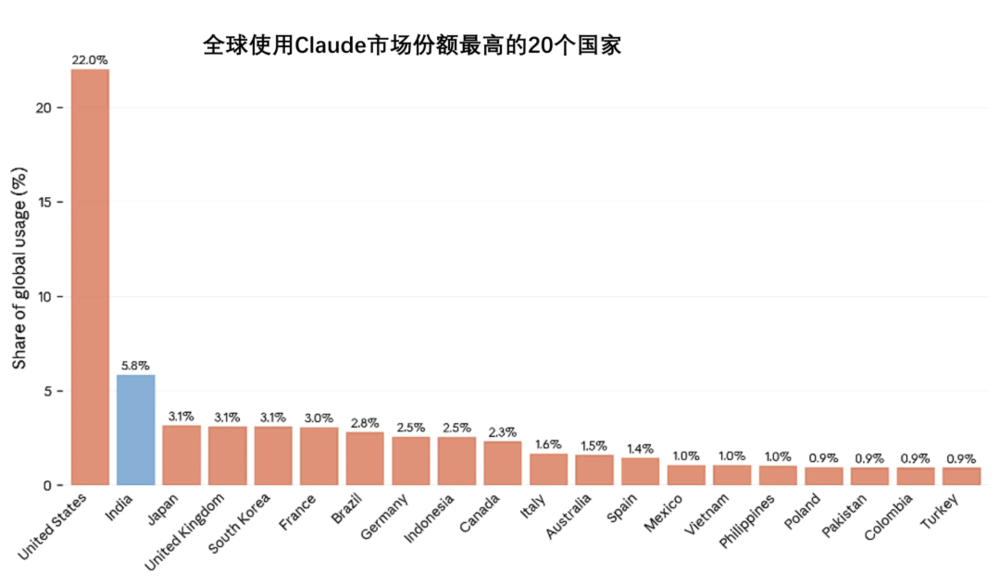
The Anthropic Economic Index shows that India is Claude's second-largest market; more importantly, Anthropic found that Indian users' use of Claude is markedly skewed toward professional purposes, with nearly half of usage involving computer and mathematics tasks, including developing applications, modernizing legacy systems and actually deploying software into production environments.
In other words, Americans created Claude Code, and the population that uses Claude Code most fanatically in the world happens to be in India, which in the past relied on human labor to write code.
Bar chart of the top 20 countries by share of global Claude usage, led by the United States at 22.0%.
(Source: Anthropic Economics)
India has the world's largest group of Gemini users aged 18 to 24, and India is the country with the largest population using Gemini for learning every day. So what is worth observing over the long term is that AI will hit India first, and may also be absorbed by India at scale first.
Because AI adoption does not depend only on population, but on how many people in a society already have daily work that is fundamentally text, code, data, process and knowledge operations. India happens to have many millions — even tens of millions — of such workers.
Rather than asking whether AI will destroy Indian programmers, the better question is: if six million technology workers suddenly gain agents, how much more software and knowledge services can they produce?
Global enterprise services, the "US-India axis"
If this trend continues, a very interesting global industrial structure for the AI era is taking shape. The United States has OpenAI, Anthropic, Google, Microsoft, Amazon, as well as the world's most powerful foundation models, cloud platforms, capital markets and enterprise software companies.
India has the world's largest pool of technology services talent, a mature cross-border delivery system, trust relationships accumulated by global enterprises over decades, and a growing number of GCCs, data engineers, industry experts and AI deployment staff.
So AI enterprise services may form a new global division of labor: the United States is responsible for creating models, clouds, software platforms and core IP; India is responsible for embedding these capabilities into the truly complex business processes of banks, hospitals, insurance companies, automakers, manufacturing and governments. It used to be called outsourcing; in the future it may be closer to AI orchestration.
The United States provides the "engine" of intelligence, and India provides the engineering system that installs the engine into the machines of millions of enterprises. But it is still too early to say that future global enterprise software will be jointly dominated by "the US + India." The real question lies in value capture.
The two figures from NITI are the ones most worth remembering: India accounts for about 20% of the global technology services market, but only 1% to 3% of the global SaaS market. If this ratio remains unchanged ten years from now, then the so-called "US-India dominance" will in fact still be this: the United States owns the models, software, IP and profits, while India provides implementation, operations and manpower.
Only when Fractal, Coforge, Persistent, Sarvam and a group of companies that do not yet exist today turn India's decades of accumulated industry knowledge into agents, platforms, data products and global software will India truly complete its second leap.
True, AI is "shorting" India's IT outsourcing, Indian IT employment is decoupling from export growth, hiring at large companies is stalling, junior programmers are under pressure, and the old model of billing by the hour is collapsing. At the same time, NASSCOM (the National Association of Software and Service Companies) expects employment across the entire technology industry to still grow by about 2.3% in 2026, reaching about 6 million people, but the growth is increasingly coming from GCCs, AI, data, cybersecurity and new enterprises, rather than the old outsourcing machine that kept swallowing college graduates.
So this round of change may ultimately produce a very counterintuitive result: India's software outsourcing industry may be weakened by AI, while India's position in global software and knowledge services may instead be strengthened by AI.
Because millions of people who understand code, AI, banking, automobiles, pharmaceuticals, ERP and global enterprise processes are clustered in Bangalore, and each of them now has ten more agents beside them that never sleep.
Related materials:
https://www.niti.gov.in/node/2184 "NITI Aayog"
https://think.ing.com/articles/why-ai-matters-for-india-and-the-philippines/
https://www.ar.tcs.com/introduction/about-tcs/
https://www.persistent.com/investors/financial-results-and-reports/annual-reports/
https://openai.com/index/openai-for-india/
https://www.anthropic.com/research/india-brief-economic-index
If you have objections to or complaints about this manuscript, please contact tougao@huxiu.com.