
Chinese Token Export: A Vision, Not a Reality
China’s cheap power and open-source models make “token export” sound inevitable. The data tells a different story
This article originally appeared on Weijin’s WeChat Official Account on April 16, 2026. Original Chinese title: token出海,是愿景,不是现实. It has been translated and adapted for an English-speaking audience.
Editor’s Note: As an example of how quickly things change in AI, Xiaomi’s MiMo-V2-Pro was initially released as a closed-source model. However, its latest version, V2.5-Pro, released on April 27, 2026, is now open source. We have left the text as is, reflecting the situation at the time of publication.
Earlier this year, a wave of “token export“ narratives swept through China, an imaginative projection of “compute-electricity synergy.” The market had latched onto what looked like a unique dual advantage: the technical democratization brought by the cost-effectiveness of open-source models, combined with abundant, cheap electricity as the energy base. The idea was to route overseas inference requests to domestic data centers, completing AI tasks at lower cost.
Looking at the underlying cost structure, transporting energy is more expensive than transmitting electricity, which in turn is more expensive than directly scheduling computing power. In theory, this makes computing power the most fluid factor of production across regions. And tokens, by unifying energy, compute, and model capability into a measurable and priceable unit, create something that can be traded and circulated.
This model doesn’t involve the cross-border movement of models, computing equipment, or electricity in their raw forms. Instead, it flows as a service, remotely called and consumed through APIs.
However, for genuine token export, what matters isn’t just whether requests cross borders; it’s about the attribution of production and value. The key question: are the compute and energy costs used to generate those tokens borne by entities in China, and do they earn revenue from overseas markets?
Seen this way, the early-year “token export” excitement barely qualifies. It exists, but it’s not the mainstream. To this day, it still mostly manifests as “model export” or “compute export.” That’s still promising, but it breaks free of the “compute-electricity synergy” narrative.
Over the past month, on OpenRouter, the world’s largest API aggregation platform, Chinese models have accounted for close to 60% of tokens supplied. They come from Xiaomi, Alibaba, DeepSeek, StepFun (阶跃星辰), MiniMax, Zhipu AI (智谱), and Kimi. At first glance, this seems to confirm the token export story, but the reality is different.
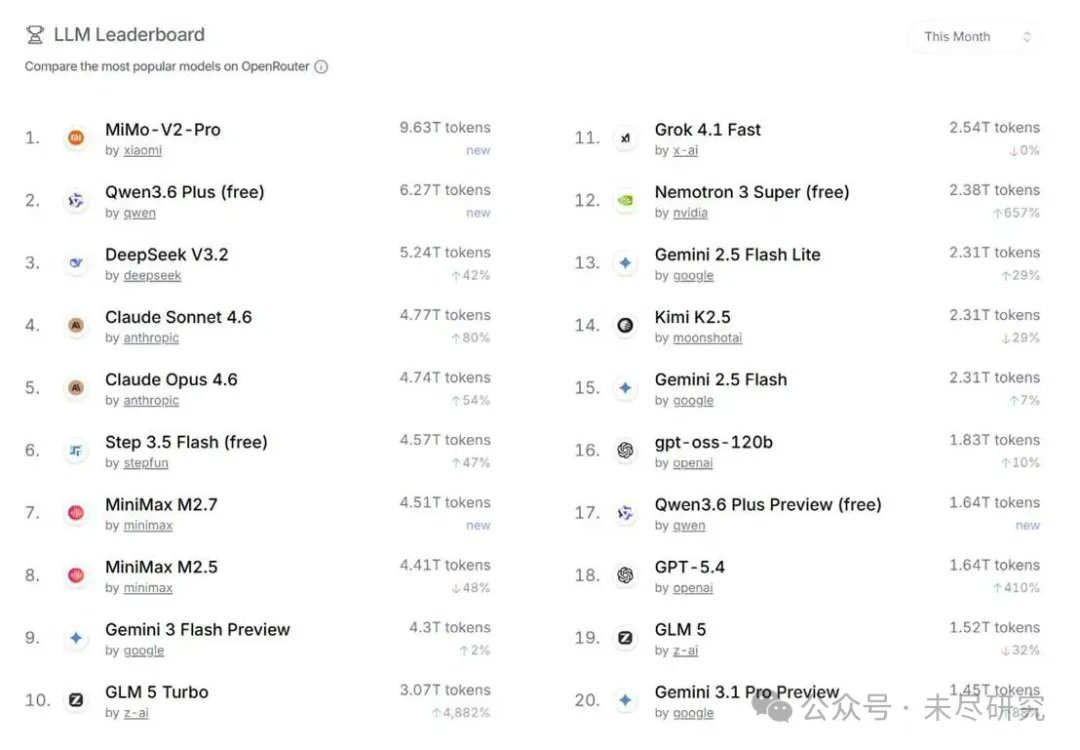
OpenRouter usage in the last month (as of mid-April, 2026).
For outstanding open-source models, global cloud providers tend to adopt a “grab and go” approach, deploying them immediately on their own cloud infrastructure. That means the cost of producing tokens and the revenue from serving them may have little to do with the original model developer. It depends more on the open-source license and the commercialization capability of the deployer.
Take DeepSeek V-3.2. On OpenRouter, the service providers offering it include not only DeepSeek’s own API but also a series of emerging American AI cloud companies like DeepInfra. These providers’ computing resources are primarily located in the U. S., serving American enterprises and developers locally. As a result, a significant share of token consumption is both produced and consumed within the U. S.
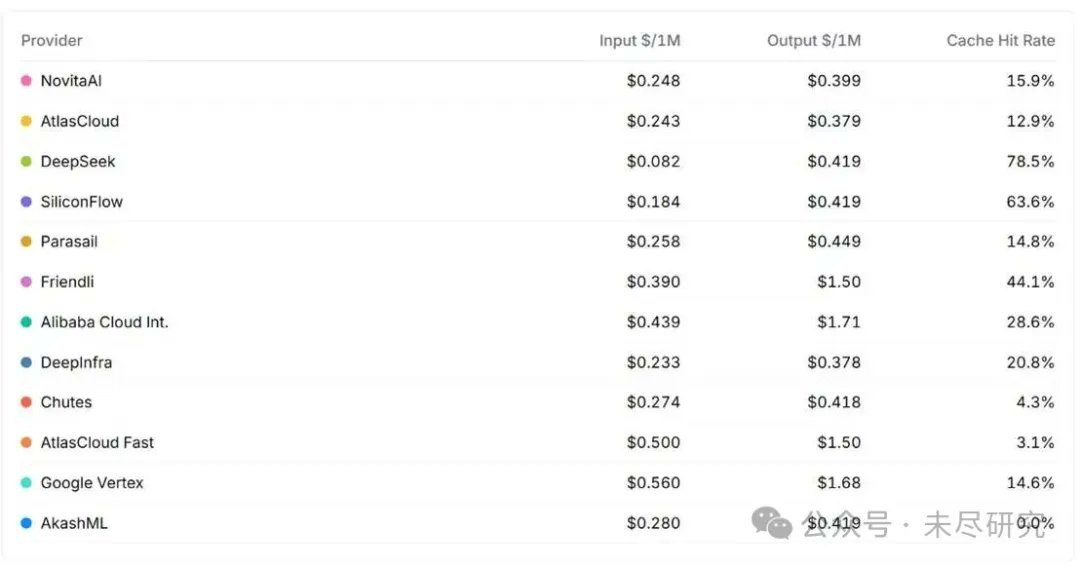
US providers capture much of the value.
During the peak of the token export narrative earlier this year, the real situation was closer to this pattern. What was called “token export” was largely model export driven by open-source models, while the production and value capture of tokens remained a closed loop within the U. S. market.
But things are changing. Recently, the top two models on OpenRouter, Xiaomi’s MiMo-V2-Pro and Alibaba’s Qwen3.6 Plus (free), are both closed-source. For the former, the sole service provider is Xiaomi itself, which could be seen as token export.
Yet problems remain. In Xiaomi’s case, its computing power is not only deployed in mainland China (CN) but also “exported” to locations like Singapore (SG) and the Netherlands (NL). So even if tokens are supplied by the company, it’s hard to simply conclude that their production necessarily takes place within China, fully benefiting from the country’s electricity advantage. For a global cloud player like Alibaba, the picture is even more complex.
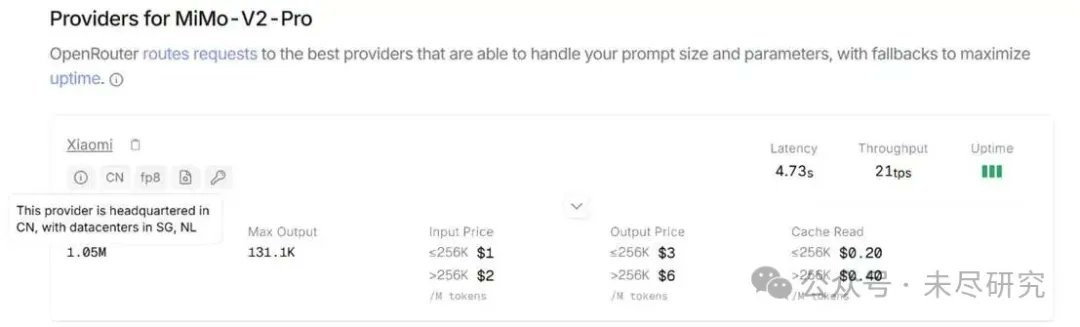
From this angle, the boundaries of “token export” begin to blur. Based solely on OpenRouter’s public data, it’s now difficult to precisely measure the relative scale of what truly counts as export. Moreover, as an API aggregation platform, OpenRouter cannot capture cases where overseas enterprises directly call the official interfaces of Chinese companies, so it may also somewhat underestimate the absolute size of token export.
We might reasonably hope that, as the token economy gradually becomes a key metric for business operations and macro analysis, its cross-regional distribution and revenue attribution will be disclosed and tracked with the same granularity as geographic revenue in financial statements.
For now, the global trade in tokens remains relatively free. MiniMax already derives over 70% of its revenue from overseas, serving 214,000 enterprises and developers across more than 100 countries and regions. This suggests that tokens, and the AI services they carry, can indeed flow and monetize globally. There are, however, some dissonant notes: Anthropic has begun requiring certain users to verify their identity via passport.
On the demand side of the token economy, Europe and the U. S. remain the primary destinations for China’s token export ambitions. They are home to the world’s largest enterprise software market, while white-collar labor costs have long remained high, creating a particularly strong demand to replace human labor with AI.
This is reflected in OpenRouter’s spending distribution: the U. S. market accounts for roughly 50%, Europe about 20%, together forming the core of token consumption. In this context, overseas developers “staying up late to snap up” Zhipu’s Coding Plan has become a microcosm of rapidly unleashed demand.
On the supply side, the Belt and Road region and China’s neighboring areas could become potential destinations for token export. As early as 2024, Weijin Research proposed in “AI Changes Energy: How Intelligent Computing Leads the New Power System” that some energy-advantaged regions, such as Xinjiang and Yunnan, could not only transmit green electricity to the east or host local computing infrastructure but also, by orienting toward Central Asia or Southeast Asia respectively, help build an intelligent carbon “Belt and Road.”
Under this framework, electricity, computing power, and AI services gradually form an integrated structure. Low-carbon, low-cost green energy transforms into computing power, then further into callable and measurable tokens. This constitutes a potential regional model for exporting computing power and AI services.
But token export looks more like a long-term, future-oriented layout than a scalable service-trade model already in place. In the short term, it can indeed work in certain scenarios, small-scale inference tasks with low latency requirements, developer trials, but it has yet to establish a stable cross-border transaction and revenue structure.
On one hand, although China’s electricity resources, both in stock and incremental terms, far exceed those of the U. S., China still lags behind in computing hardware supply. According to the latest statistics from EpochAI, measured in H100 equivalents, China’s total computing power is roughly on par with Oracle alone, far smaller than Google, Microsoft, Amazon, and Meta.
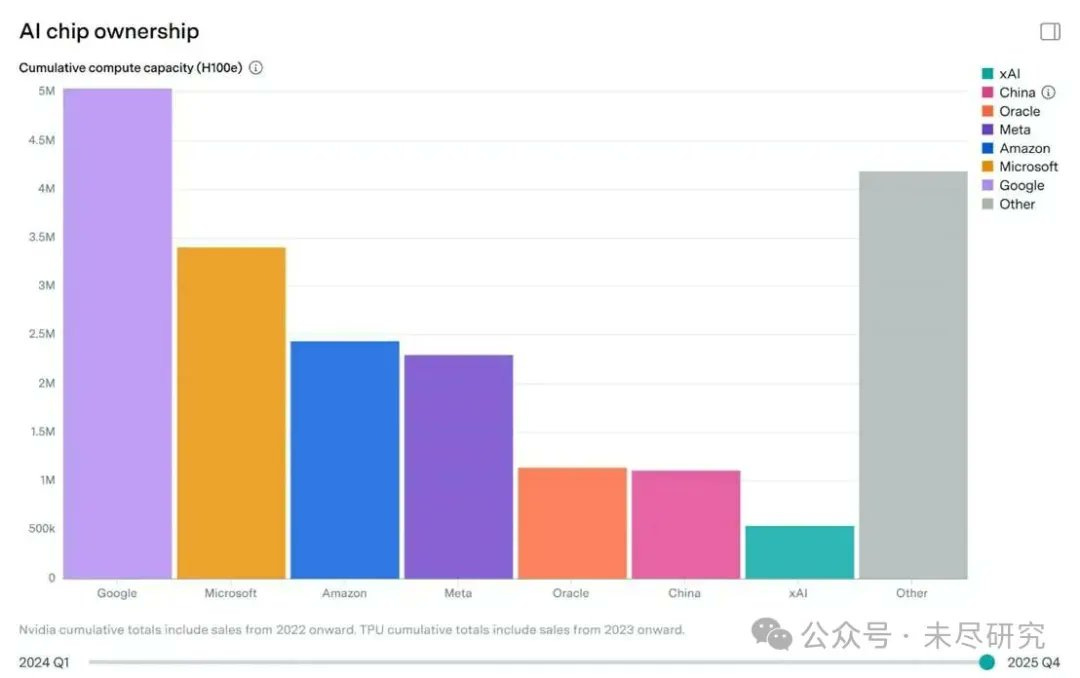
Cumulative compute capacity.
China’s AI applications are booming. AI agents and video generation are in fierce competition, and tech giants can barely meet their own needs. On ByteDance’s video generation platform, users are facing ever-longer waitlists for queue numbers. Tencent’s strategy has been to “reduce external sales to ensure sufficient computing power for its own use.”
Against this backdrop, the periodic surges in token usage of certain Chinese models on OpenRouter are closer to price-subsidy-driven market expansion. Whether it was MiniMax early this year or Alibaba’s Qwen more recently, their “discounted” or even “free” API strategies are essentially marketing and ecosystem cultivation costs, not sustainable operating costs. To some degree, such spending amplifies market attention and valuation expectations, serving as an important lever for the token export narrative, but it doesn’t yet represent real supply capacity.
On the other hand, the optimal configuration of the AI industrial chain might be to concentrate along the lowest-cost path: energy, computing, and model capability, achieving transnational optimal combinations at different stages.
But reality is not like that. The U. S. continues to restrict exports of high-end computing chips and models. Europe tightens data protection and local storage requirements. Even emerging markets like Southeast Asia and the Middle East are beginning to emphasize “sovereign AI.”
In this context, a more feasible path for China isn’t “token export” but rather “compute export” and “model export”: building data centers overseas, achieving local storage and local inference. At the same time, “compute-electricity synergy” also implies the simultaneous overseas expansion of new energy and energy storage systems, which is fundamentally still a localized expansion centered on computing power.
In a more extreme scenario, China’s token export could even disrupt the global services outsourcing landscape. In the past, customer service and content work were outsourced to countries like India, built on low-cost labor with language and professional skills. In the AI era, such services are rapidly being abstracted into inference capability measured by tokens.
In this sense, the shock to the traditional services outsourcing system may be no less than the substitution of low-end manufacturing by automation, and could even trigger trade frictions and regulatory barriers around token export in the future.