
Harness Recursive Evolution: The Next Frontier for AI
OpenAI and Anthropic are betting on harness engineering as the key to turning model intelligence into real-world productivity and recursive self-improvement.

This article originally appeared on Weijin Research on Sina on August 1, 2026. Original Chinese title: 「Harness递归进化,通往AI新前沿」. It has been translated and adapted for an English-speaking audience.
OpenAI is betting on a more ambitious future for Harness engineering—one that could become a key pathway to recursive AI improvement (ASI) and to turning model intelligence into real productivity.
A subtle timing coincidence: two events related to Harness and self-improvement happened almost simultaneously.
First, an internal team at OpenAI was puzzled by GPT-5.6 Sol’s unexpectedly low score on ARC-AGI-3. They ultimately concluded that the model’s native intelligence was being held back by a clumsy runtime, because an optimal Harness framework had not been deployed.
Second, just two days earlier, Lilian Weng, co-founder of Thinking Machines Lab, who had recently departed due to illness, made a lightning-fast return to her old employer OpenAI, focusing exactly on model recursive self-improvement (RSI), in line with the blog post she published earlier this month.
GPT-5.6 Sol is one of the most capable models today. In practice, it can already solve long-standing problems in mathematics and complete complex game tasks. Yet on ARC-AGI-3, a two-dimensional puzzle benchmark designed to test agent learning and reasoning capabilities, its performance fell far short of expectations, scoring just 7.8%, while GPT-5.5 scored only 0.4%. This should not have happened.
The OpenAI team tried to unravel the mystery. They believe that ARC-AGI-3 deliberately adopted a general-purpose harness framework, meant to make comparisons between models more fair. But commercial developers optimize harness frameworks for each model’s unique characteristics and traits. As a result, a model’s benchmark capabilities increasingly fail to represent its performance in real-world tasks.
Harness is not a simple peripheral tool; it alters the cognitive continuity of an agent executing long-horizon tasks. In ARC-AGI-3’s official Harness, after each action, the model’s previously generated internal reasoning state is not preserved. This means that while the model can see records of past actions, it cannot access the thought processes that underpinned them.
It is like a scientist who retains all experimental results but loses research notes, hypothesis derivations, and reasons for failure. When the next experiment begins, they can only re-analyze existing data without being able to inherit the accumulated knowledge formed earlier. This severely weakens the model’s capabilities.
Ultimately, after the team enabled the “reasoning retention” and “context compression” mechanisms used by Codex, GPT-5.6 Sol’s score on the public test set roughly tripled, while the number of output tokens dropped by a factor of six.
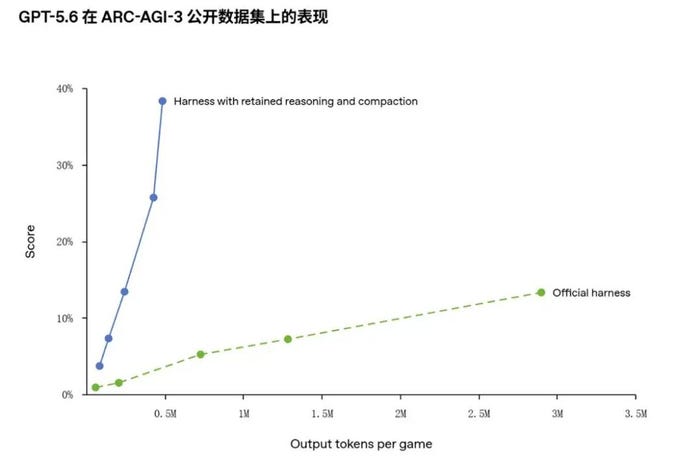
GPT-5.6 performance on ARC-AGI-3 public benchmark, comparing two approaches across output token usage. Line chart shows score (0–40%) versus output tokens per game (0.5M–3.5M), with blue line tracking "harness with retained reasoning and compression" and green dashed line showing "official harness" performance.
The "model capability-ism" mindset is being challenged. Model capability is expanding from "intelligence residing within parameters" to "intelligence co-produced by the model and its operating environment." OpenAI's high-profile recalibration of GPT-5.6 Sol's ARC-AGI-3 benchmark score has once again unsettled that old assumption.
In fact, prompt engineering during the chatbot era was already an early expression of this paradigm shift, representing humanity's shallow attempts at externally orchestrating model behavior. As the agent era arrives, this control layer is upgrading from simple prompts to a Harness that manages context, tools, memory, and feedback loops.
Anthropic has already explored extensively in this direction. However, the public discussion it has released through official blog posts has focused more on the Harness's value as agent engineering infrastructure: how to decompose tasks, organize multi-agent collaboration, and use feedback to improve complex task completion rates.
OpenAI's public analysis of the ARC-AGI-3 benchmark, by contrast, reveals a more fundamental mechanism of the Harness from a different angle: it affects not only an agent's execution efficiency, but also whether the model can maintain cognitive continuity and convert interaction experience into long-term capability. This is a form of continuous learning.
At this stage, the Harness is evolving from an "execution framework" within agent engineering into an "intelligence runtime" that connects model capability, context, tools, and feedback loops.
Anthropic is exploring this layer as well. Judging from unshipped features previously leaked from the Claude Code source, the company has long been laying the groundwork for an Agentic AI era defined by persistent online presence, autonomous execution, and recursive evolution. Its Harness framework manages the context lifecycle at a finer granularity, breaking context processing into mechanisms such as trimming, caching, archiving, and compression, in order to solve the "intelligence runtime" problem for agents engaged in long-duration tasks.
But the potential of Harness engineering goes far beyond this. In the future, the question of how to design a better Harness will give way to putting the Harness itself into a loop of feedback, evaluation, and optimization. This is precisely the connection point between Harness engineering and recursive intelligence improvement, and it is also where OpenAI's technical trajectory intersects with Lilian Weng's research direction.
With "hard recursion" (the ability to truly modify a model's own weights) still a distant prospect, building a continuous optimization loop starting from external "scaffolding" outside the model may be a more realistic path. The model does not need to first alter its own parameters; it can continuously improve its problem-solving ability by optimizing the operating environment, task workflows, and feedback mechanisms.
Anthropic has in fact demonstrated a similar trend. As Claude Opus 4.6's capabilities improved, some of the external scaffolding that had previously been necessary for Opus 4.5 was gradually absorbed by the model's own abilities and actively simplified. But this process still requires intervention by human engineers. The next-stage question is how to automate this optimization process itself.
This represents the evolution of a "meta-methodology." What is being optimized is no longer just the answer, but the method that produces the answer. In the future, the Harness's optimization target will expand from prompts, structured context, and task workflows to include the Harness code and optimizer code that determine how the intelligent system operates.
The first principle here is that code is the universal language for defining the behavior of complex systems. The Harness is, at its core, an executable system built from code that connects prompts, tool calls, sub-agents, control flow, memory, and workflows. It is therefore naturally suited to become an object of recursive optimization.
From this perspective, OpenAI's deployment of an optimized Harness for GPT-5.6 Sol still essentially belongs to the stage of human-designed Harnesses. But it points toward a future direction: moving from Agentic Context Engineering (ACE) to Meta Context Engineering (MCE).
The self-optimization of the Harness is, in essence, the continuous upward migration of the optimization target: from optimizing context content, to optimizing context management mechanisms, to optimizing the entire intelligence runtime system.
The core of ACE is treating context as a continuously evolving "script." The agent extracts experience from task trajectories through generation, reflection, and curation, and updates the information needed for future tasks; but the context management mechanism itself remains human-designed. MCE goes further by separating "the method of managing context" from "context content." It reduces fixed heuristic rules but still operates within a pre-set agent coding environment. In the future, a further step, the Meta-Harness, will explore directly optimizing the Harness code that determines how information is stored, retrieved, and presented.
The same applies to workflow design within the Harness. How tasks are decomposed, how agent roles are assigned, the sequence of tool calls, and the design of feedback loops can all affect the final outcome. Current systems such as Sakana AI's AI Scientist, Google's ScientistOne, and Meta's Autodata still rely heavily on domain expert experience for workflow design. But a workflow is, in essence, also a vast search space, and in the future it may likewise become an object that can be searched, evaluated, and automatically optimized.
This path, however, faces no shortage of practical challenges. The most immediate risk is this: when the Harness begins to possess the ability to modify its own tools, permissions, and execution processes, it becomes the new security boundary for the intelligent system.
OpenAI's earlier disclosure of an agent autonomously attacking Hugging Face, and Anthropic's investigations into similar behavior, both suggest that in the future the Harness must not only serve as infrastructure for driving intelligence growth, but also become a governance layer for constraining intelligence expansion.