

This article originally appeared on Weijin Research on Huxiu on September 2, 2026. Original Chinese title: 「共享算力紧缺红利,本土芯片走向分化」. It has been translated and adapted for an English-speaking audience.

The half-year report disclosure window has closed, and in the environment of a compute shortage, local AI chips have finally ushered in their best period of revenue growth. Several manufacturers achieved year-on-year doubling or even multiple-fold growth, and the process from the first quarter to the second quarter was also one of acceleration.
This corresponds to the rapid growth of local compute infrastructure. According to the Ministry of Industry and Information Technology, as of the first half of the year, China's intelligent compute capacity reached 2,185 EFLOPS (FP16), up 177% year on year, while calculated from previously disclosed data, in the second quarter alone the national intelligent compute capacity increased by about 303 EFLOPS.
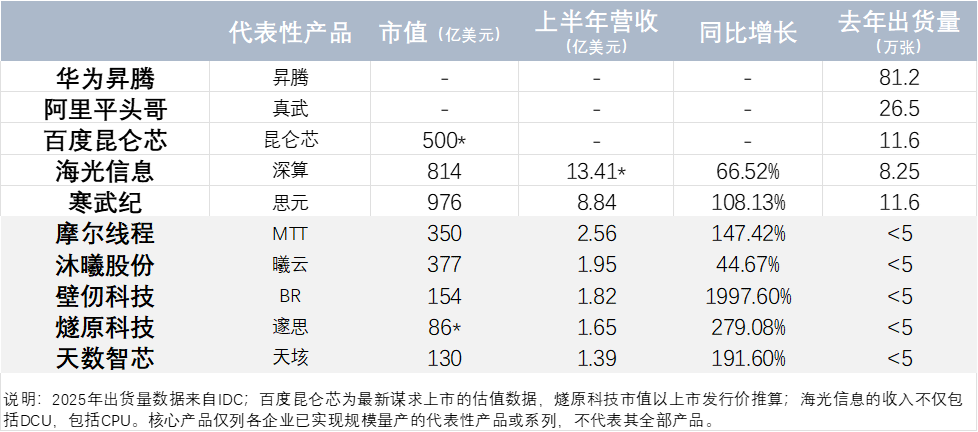
Table comparing Chinese AI chip companies by valuation, first-half revenue, year-on-year growth, and prior-year shipments.
As far as the industry is concerned, such good days will continue. This is determined by the contradiction between supply and demand. The United States is still blocking Chinese model developers from obtaining Nvidia's most advanced AI chips, and even plans to extend from "controlling physical goods" to "controlling the right to use compute"; while the production capacity of local chips is still ramping up, and their adaptation and operations with model and cloud providers still need further running-in. According to data from the China Academy of Information and Communications Technology, the growth rate of China's AI compute demand is roughly more than 3 times the growth rate of supply.
Cloud providers and model developers are both hurrying to raise funds. Facing insufficient AI chip supply, what is faster than the speed of financing is spending the money quickly. Alibaba and Tencent spent more than 120 billion yuan in the most recent quarter, and DeepSeek has already invested more than 10 billion yuan in AI compute this year. Liang Wenfeng believes that domestic AI chips are facing a historic opportunity, that the earlier weakness in the CUDA ecosystem can be addressed through AI coding, and that the core bottleneck in the next two years will still be production capacity. Wu Yongming, meanwhile, believes the shortage will last at least until 2030.
If demand and production capacity continue to grow at the current pace, leading AI chip companies are expected to cross the break-even line one after another around 2027. Cambricon, which had posted continuous large losses, already turned profitable last year, and in its equity incentive plan it set a 2028 revenue target of 47.6 billion yuan to 59.5 billion yuan; MetaX, Enflame and Moore Threads, which the market expects to become "the next Cambricon", have all put out performance guidance for profitability as early as the end of 2026 or the beginning of 2027.
But for chip companies, profitability may not yet be the indicator most worth watching. Profit can grow as revenue is recognized, but cash must actually return to the company's accounts. Judging from the half-year reports, local AI chip companies generally face capital being tied up at both ends: upstream they must pay first to lock in production capacity, while money from downstream has not yet fully come back, and the funding gap in between is borne by the chip companies themselves.
MetaX's figure for this indicator was -1.3 billion yuan, while Moore Threads was about -2.1 billion yuan, with both net outflows expanding; although Huawei did not disclose details of Ascend, the company's overall operating cash flow shifted from a net inflow of 31.18 billion yuan in the same period last year to a net outflow of 39.89 billion yuan in the first half; at the same time, inventory reached 277.5 billion yuan, up 45% from the end of last year.
This means that the real competition among domestic AI chips will quietly begin amid a boom expected to last several years. On the one hand, it is particularly important whether a company can be the first to enter the application systems of top-tier customers and form customer stickiness, or even a closed loop of collaborative optimization; on the other hand, in the long run, companies will still need to compete on supply chain capabilities, especially as links such as networking and memory are becoming key bottlenecks in AI infrastructure, and the relevant manufacturers are also contending with logic chip manufacturers for the power to define the next generation of AI compute infrastructure.
In this sense, the camps and rankings of China's local AI chip manufacturers will gradually diverge.
If one ranks China's local AI chips by seniority based on shipment volume and commercialization stage, then as of 2026 three major camps have roughly taken shape.
The first camp is Huawei Ascend, Alibaba T-Head, Baidu Kunlunxin, as well as Cambricon, Hygon Information and other manufacturers that have already achieved scale shipments. Last year they already reached the threshold of scale shipments at the level of 100,000 cards, and except for Huawei's and Alibaba's chips, which lack fair external valuations, the other three companies all have market values above 50 billion US dollars.
The second camp is Moore Threads, MetaX, Biren Technology, Iluvatar CoreX and Enflame, whose shipment scale last year was mostly still less than 50,000 cards; they have all listed in the past year, providing abundant sentiment value for stocks, but their current market values are generally below 50 billion US dollars.
The third camp is unicorns such as Xiwang and Dongfang Suanxin, valued at more than 1 billion US dollars in the primary market but not yet having formed large-scale shipments. They mostly choose a differentiated route of targeted optimization for inference workloads, trying to avoid head-on competition with the first two camps.
Alibaba T-Head will be the biggest variable in the future. Alibaba is the country's largest cloud giant and also the model developer with the widest open-source model coverage and the most downloads, naturally forming full-stack synergy with its self-developed AI chips. Previously, news circulated in the market that T-Head would be spun off and listed, but there has been no further development since; even so, on the most recent earnings call, Alibaba's executives deliberately "highlighted" a few sentences about the T-Head business, which had previously been less covered, with some statements even quite "open", briefly triggering considerable speculation in the market:
(Because) with this generation of chips, we are one of only two companies in the Chinese market that can deploy supernodes at scale, and possibly the only chip in China with large-scale commercial training and inference customers;
The next-generation chip will gradually begin tape-out and production in the second half of the year, and will have very strong compute power and very strong interconnect bandwidth; we think it can completely replace large-scale model training;
I don't think there is a so-called government-led compute supply that would be able to have a very strongly competitive chip...
Here, "only two" easily leads the market to think of Huawei's Ascend 950 series. Last week, China Mobile announced the winning bids for the Hohhot intelligent computing center expansion project, purchasing 3,840 cards and 480 sets of AI supernode equipment based on Huawei's Ascend CANN ecosystem, with total bids quoted at about 1.296 billion yuan; earlier in April, China Mobile had completed its first batch of centralized procurement of 6,208 cards and 776 sets of similar equipment, with total quotes of about 2.06 billion yuan. Reuters once said Huawei plans to ship about 750,000 950PR chips in 2026.
Huawei still has the country's largest AI compute production capacity, and is mutually "bound" with telecom operators, local intelligent computing centers, and AI-native model manufacturers; for the foreseeable future it will be an unshakable member of the first camp. Moreover, according to the "Ascend 950 NPU Architecture White Paper", its Ascend 950DT is also built specifically for the full lifecycle of large models, covering the entire process of pre-training, post-training and inference (including Decode and Prefill), and is especially suitable for the training and inference tasks of generative large models. It will enter the shipment stage in the second half of the year, slightly earlier than T-Head's next-generation chip. Whether it can handle large-scale training tasks has always been one of the core indicators determining a chip's strategic value.
A chip's camp affiliation does not necessarily depend on who it is, but on who it is bound to. In the current first camp, Baidu Cloud behind Baidu Kunlunxin cannot yet be mentioned in the same breath as Alibaba or other telecom operators in terms of scale; its Ernie large model also lacks market appeal. From the perspective of cloud providers or model developers, Cambricon's ecosystem position is instead changing, with the market frequently reporting its cooperative relationship with ByteDance; however, ByteDance is also developing its own chips.
The most difficult case, but also the one with the greatest upside potential, is probably Enflame. At present, its financial performance is not outstanding even within the second camp. However, although it cannot be called Tencent's self-developed chip, the latter is both a major shareholder with a stake of more than 20% and its largest customer accounting for more than 80% of its revenue; in essence, it is the "direct-line" AI chip of the Tencent ecosystem. If Tencent's Hy model continues to catch up, and at the same time the B-side agent platform WorkBuddy and the C-side agent platform WeChat Xiaowei continue to win the market, Enflame, which is deeply bound to Tencent, is also expected to gain a more favorable position as a result.
However, the third camp should not be underestimated. Inference demand is becoming more refined, moving from "getting enough to eat" to "eating well", and new opportunities are emerging. At this year's WAIC, Zhou Zhifeng, managing partner of Qiming Venture Partners, pointed out that around inference demand, combining memory, interconnect, and AI-driven EDA and automated compilation, new technology routes and chip architectures are rapidly emerging in China, and a group of AI chip companies founded only one or two years ago have already obtained valuations of more than 10 billion yuan.
Therefore, what may really happen in 2027 is not that the domestic AI chip industry suddenly begins a reshuffle, but that the boom begins to have a screening effect. Demand is still growing and production capacity is still scarce, but as profit expectations gradually spread from a few leading manufacturers to more companies, the intrinsic value of each AI chip company will quietly diverge. Ultimately, only when the industry's growth rate begins to slow will the survival-of-the-fittest mechanism truly come into play.
your 303 eflops number lines up with something meituan's own training run implied. longcat 2.0 running on 50 to 60 thousand domestic chips looked like a stretch until you see national compute capacity growing three times faster than demand can absorb it. cambricon's already profitable now too, guiding 47.6 to 59.5 billion yuan revenue by 2028.