
Thinking Machine Lab’s Inkling Model Targets Trust and Flexibility in Open-Source AI
Built on lessons from DeepSeek and Kimi, Inkling seeks to match Chinese peers with a focus on factuality, safety, and customization.

This article originally appeared on Weijin Research on Sina on July 16, 2026. Original Chinese title: 「美国出了个开源模型Inkling,借鉴DeepSeek和Kimi冲到前沿,要比GLM 5.2更可信安全」. It has been translated and adapted for an English-speaking audience.
One big reason for that speed: Inkling borrows from DeepSeek V3's MoE (Mixture of Experts) architecture, and it kicked off its post-training reinforcement learning with an initial round of supervised fine-tuning on data generated by Kimi 2.5.
Inkling is an open-weight MoE model with 975 billion total parameters (41 billion active). It supports a context window of one million tokens and was trained on 45 trillion tokens of text, images, audio, and video.
TML also released a preview of Inkling-Small, a lighter model with 276 billion parameters (12 billion active). Trained using a similar method, it targets lower cost, lower latency, and the strongest performance that can be squeezed out of a smaller footprint.
The public face of TML is its two female co-founders: former OpenAI CTO Mira Murati and Lilian Weng, OpenAI's former VP of alignment research.
They say Inkling's strength is how easy it is to customize — its multimodal capabilities, its efficient thought process, and the fine-tuning tools on the Tinker platform. It's built as a more general, balanced model, flexible enough to roll with whatever comes next.
TML argues that sustained reasoning (test-time scaling) and real problem-solving ability are critical for any model, but they don't show up well on leaderboards. When developers fine-tune a model for a specific task, efficiency matters every bit as much as sweating over high benchmark scores. In the real world, cost and latency are the bigger factors.
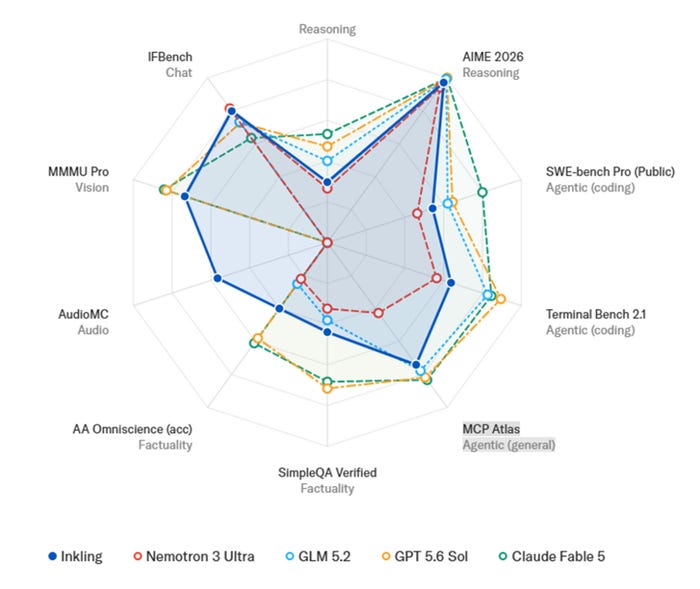
Radar chart comparing performance of six AI models (Inkling, Nemotron 3 Ultra, GLM 5.2, GPT 5.6 Sol, and Claude Fable 5) across eight benchmark categories including reasoning, coding, vision, and audio tasks.
But let's look at the model evaluation scores (see appendix at end):
In reasoning, Inkling achieves state-of-the-art in the US, but still trails China's Kimi K2.6 and GLM 5.2. The same holds for agentic coding. On general agent tasks, Inkling surpasses Kimi K2.6.
Inkling is slightly behind Kimi K2.6 in vision. It has voice capabilities, which Kimi and GLM lack. Its chat function also edges out GLM 5.2. In multimodal performance, it is on par with Qwen and weaker than Gemini.
In short, Inkling's evaluation scores sit between Kimi K2.6 and GLM 5.2. In the US, the industry considers its performance equivalent to Opus 4.6 or Gemini 3.5 Flash.
At last, an open-source model from a US startup can compete with its Chinese counterparts. Though it falls short on raw performance, it tries to serve real-world application scenarios better through generality, flexibility, and easier customization.
It aims to be "more trustworthy and safer" than Chinese models.
On factuality, Inkling scores higher (see appendix). Factuality is not about cramming the model with vast amounts of memorized knowledge. It is about proper calibration, showing measured confidence in its answers, including for questions without settled answers. This matters especially for reasoning and prediction. Inkling's fine-tuned model improves rapidly and has already surpassed leading large language models.
On endogenous safety and alignment, Inkling beats China's hottest model, GLM 5.2 (see appendix). It conducted internal evaluations and hired external testers to probe dangerous capabilities, including CBRN, cybersecurity, and loss of control. It also examined human-computer interaction threats such as sycophancy, malicious manipulation, and vulnerable users. On the FORTRESS benchmark, Inkling shows the strongest endogenous safety safeguards among all open-weight models.
For training, Inkling adopted the MoE design from DeepSeek-V3. To bootstrap post-training, Inkling ran initial supervised fine-tuning using synthetic data generated by open-weight models, including Kimi K2.5. The bootstrapping process consumed only a small amount of compute. Most resources went to large-scale reinforcement learning on synthetic and human-crafted environments.
Inkling was trained on NVIDIA GB300 NVL72 systems, scaling reinforcement learning to over 30 million iterations. It maintained stable training across two long continuous runs. Throughout the process, inference performance improved log-linearly, ultimately delivering a significant overall gain. Future models will further scale compute for pre-training, post-training, and reinforcement learning.
TML believes that even the best general-purpose models cannot solve many real-world problems well. Fine-tuning with organizational expertise can close that gap.
References and data: https://thinkingmachines.ai/news/introducing-inkling/
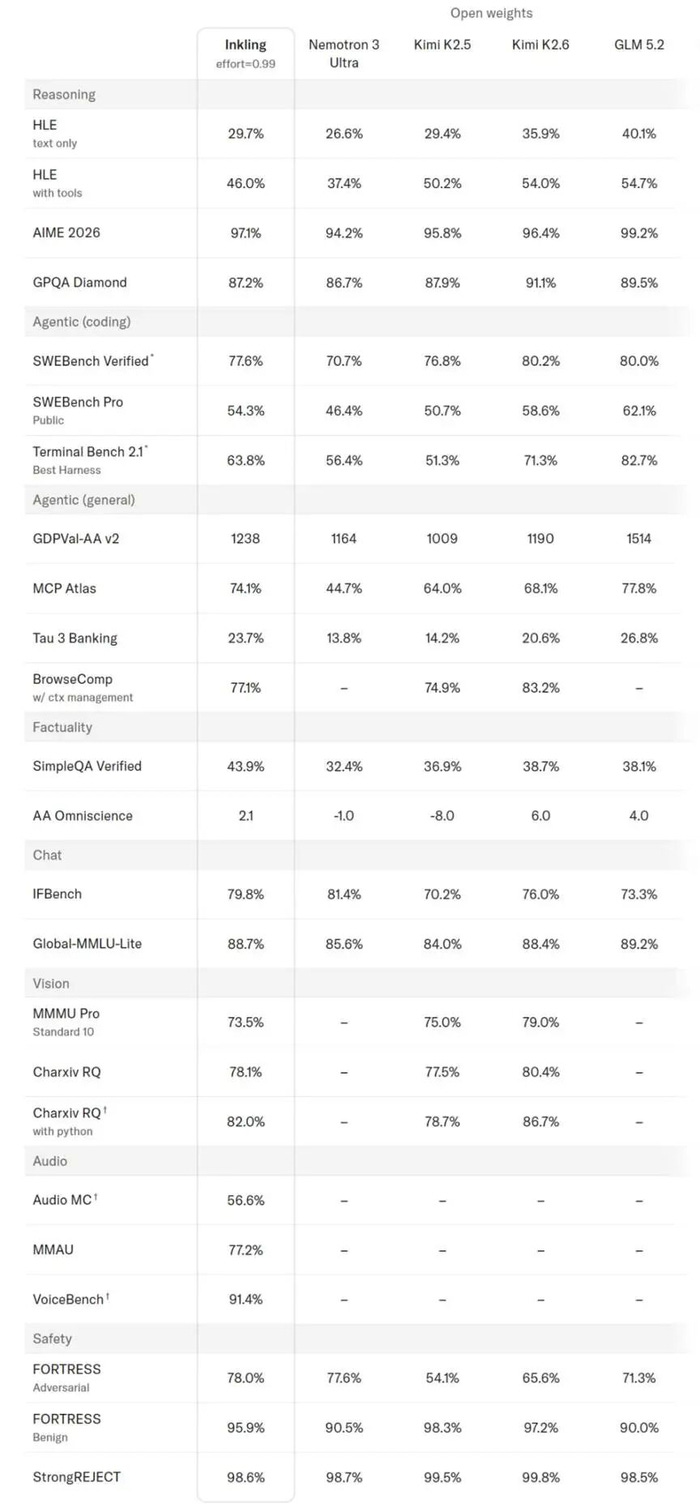
Benchmark performance comparison across five open-weight language models (Inkling, Nemotron 3 Ultra, Kimi K2.5, Kimi K2.6, and GLM 5.2). Table shows scores across reasoning, coding, general chat, vision, audio, and safety tasks, with effort metric noted for Inkling.